
Better Bid Increments Mean More Money Raised
Most silent auction organizers treat bid increments as an afterthought — a number scrawled at the bottom of a bid sheet without much thought. But the gap between each bid is one of the most consequential decisions you’ll make when designing your auction.
Set your increments too low, and bidders inch forward by a few dollars at a time, leaving significant revenue on the table. Set them too high, and you’ll see bidders walk away rather than stretch to the next rung.
This guide breaks down how to set silent auction bid increments strategically — what the research and practice of experienced organizers shows works, how bidder psychology plays into the process, and a step-by-step approach you can apply to every item category in your next event.
Set your increments too low, and bidders inch forward by a few dollars at a time, leaving significant revenue on the table. Set them too high, and you’ll see bidders walk away rather than stretch to the next rung.
This guide breaks down how to set silent auction bid increments strategically — what the research and practice of experienced organizers shows works, how bidder psychology plays into the process, and a step-by-step approach you can apply to every item category in your next event.
Why silent auction bid increments have such a big impact on silent auction results
Bid increments are the engine behind competitive bidding. When increments are calibrated correctly, they create a natural rhythm of competition — each new bid feels achievable, and bidders stay emotionally invested in winning. When they’re miscalibrated, that engine stalls.
A too-small increment on a high-value item signals to bidders that the item isn’t worth much. A $10 jump on a $1,200 vacation package doesn’t create urgency — it creates ambiguity. Bidders wonder if they’re really competing or just playing a slow game of paperwork. Meanwhile, a reasonable increment — say, $50 or $75 — tells the room that this item is genuinely in demand.
Getting silent auction bid increments right also protects your starting bid strategy. If your starting bid is set at 30–40% of fair market value, increments that are too small will mean the item rarely reaches full market value, no matter how many bids it receives. The increment is what closes that gap. Done well, it drives participation and pushes final hammer prices meaningfully higher.
A too-small increment on a high-value item signals to bidders that the item isn’t worth much. A $10 jump on a $1,200 vacation package doesn’t create urgency — it creates ambiguity. Bidders wonder if they’re really competing or just playing a slow game of paperwork. Meanwhile, a reasonable increment — say, $50 or $75 — tells the room that this item is genuinely in demand.
Getting silent auction bid increments right also protects your starting bid strategy. If your starting bid is set at 30–40% of fair market value, increments that are too small will mean the item rarely reaches full market value, no matter how many bids it receives. The increment is what closes that gap. Done well, it drives participation and pushes final hammer prices meaningfully higher.
How bidders actually think about bid increments during a silent auction
Bidders don’t evaluate items in isolation — they evaluate them relative to the last number they see on the sheet. If the current bid is $150 and the increment is $10, a bidder thinks: “Is this item worth $160 to me?” That’s a low bar, and they’ll write it in without much hesitation. But that same low bar means the next bidder faces $170, and so on — and the item limps toward its ceiling.
Contrast that with a well-set increment. A current bid of $150 with a $25 increment asks bidders: “Is this worth $175?” That’s still an easy yes for someone who values the item — but it moves the needle meaningfully. The bidder who wrote $150 now has to decide if they want to come back and write $200. That back-and-forth is where auction energy comes from.
Consider a real scenario: a spa package with a fair market value of $300, starting at $100 with $10 increments. After 15 bids — which is a lot of sheet activity — the item only reaches $250. The same item with $25 increments reaches $250 after just six bids, and competitive bidders are far more likely to push past it. For nonprofits, that difference compounds across every item on the floor.
Contrast that with a well-set increment. A current bid of $150 with a $25 increment asks bidders: “Is this worth $175?” That’s still an easy yes for someone who values the item — but it moves the needle meaningfully. The bidder who wrote $150 now has to decide if they want to come back and write $200. That back-and-forth is where auction energy comes from.
Consider a real scenario: a spa package with a fair market value of $300, starting at $100 with $10 increments. After 15 bids — which is a lot of sheet activity — the item only reaches $250. The same item with $25 increments reaches $250 after just six bids, and competitive bidders are far more likely to push past it. For nonprofits, that difference compounds across every item on the floor.
How to set silent auction bid increments that drive higher final prices
Anchor your increment to the item's fair market value
A common rule of thumb: set your increment at 10–15% of the item’s starting bid. For a $200 item, that’s $20–$30 per bid. For a $1,000 item, $75–$100 per increment is appropriate.
Segment your items into value tiers
Don’t apply a single increment to every item. Group items into tiers — low (under $100), mid ($100–$500), high ($500+) — and set increment rules for each tier. This saves time and creates consistency.
Set the starting bid at 30–40% of fair market value
Increments only work if your starting bid is set correctly. A starting bid that’s too high eliminates early bidders; too low and you need too many increments to reach value.
Use round numbers for increments
Avoid increments like $17 or $23. Bidders compute quickly in the moment — keep it clean. $10, $15, $20, $25, $50, $75, $100 are all easy to process and write.
Apply higher increments to items with strong demand signals
If an item has broad appeal — experiences, travel, restaurant packages — push the increment slightly higher than your formula suggests. Demand will sustain the competition even at larger jumps.
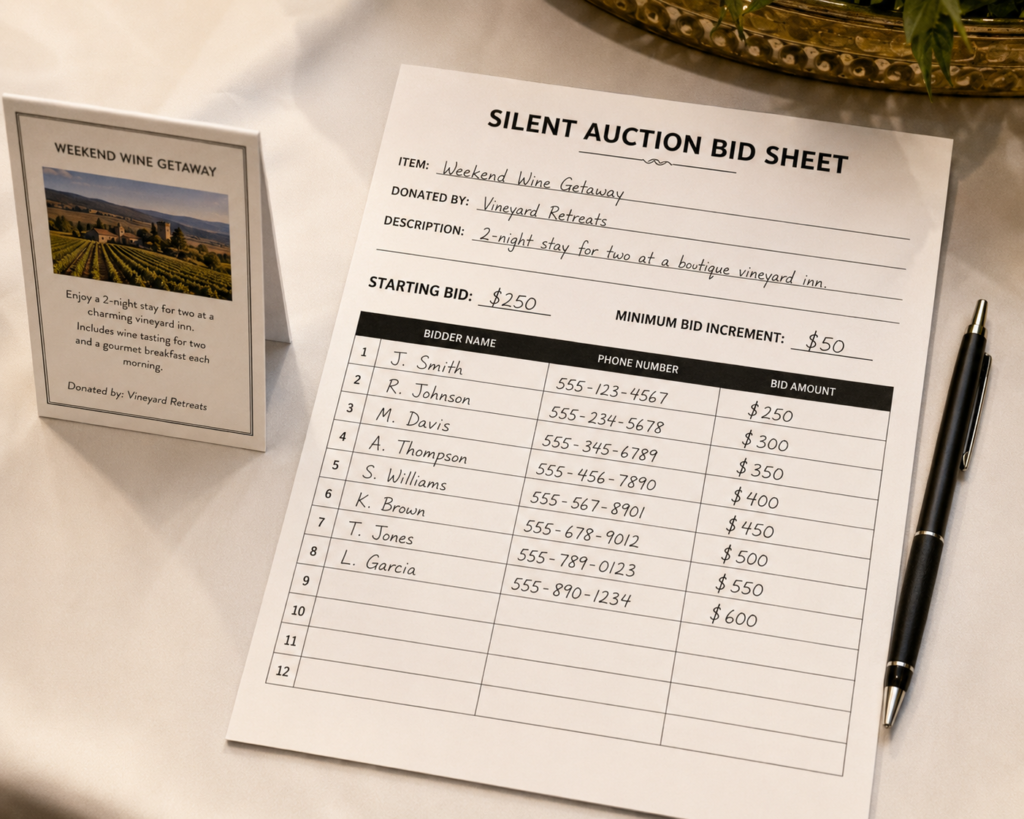
Print the increment clearly on every bid sheet
Don’t bury it. The increment should appear at the top of the sheet, next to the starting bid, in a font size that’s readable under event lighting. Confusion kills bidding momentum.
Test your increment structure before the event
Run a quick spreadsheet simulation: starting bid → increment → 10 bids. Does the final price land near or above fair market value? Adjust until the math works.
Consider a "buy it now" ceiling for select items
For some items, set a buy-it-now price — a fixed ceiling that lets a bidder end the competition immediately. Set it at 120–130% of fair market value and calibrate your increment so 8–10 bids reach that ceiling naturally.
What bid increment decisions lead to more silent auction revenue
- Items segmented by value tier consistently reach higher final prices than flat-increment auctions.
- Increments set at 10–15% of starting bid produce more competitive bidding cycles than lower percentages.
- Clear, prominently displayed increment rules reduce bid sheet confusion and keep traffic moving.
- Round-number increments are written in faster, which shortens the gap between bids and sustains energy.
- Starting bids set too high suppress early participation, making even well-set increments ineffective.
- Items with three or more bids before the midpoint of the event tend to finish significantly above starting price.
- Volunteer-assisted bidding reminders (“this item has one bid — come take a look”) extend competitive windows.
- Matching your increment to perceived item exclusivity signals value and validates the starting price.
- Auctions that pre-assign increments in the catalog allow bidders to plan their strategy before the event opens.
- Consistent increment logic across the room builds bidder trust and reduces time spent second-guessing sheets.
Common bid increment mistakes that quietly reduce silent auction revenue
- Using the same increment for every item. A $10 increment on a $50 item is appropriate; on a $600 item, it signals low value and leaves money on the table across dozens of bids.
- Setting increments too small to matter. Tiny jumps create the illusion of activity without meaningful revenue growth — bidders feel like they’re winning while the organization isn’t.
- Neglecting to print the increment on the bid sheet. Bidders who don’t know the rule either guess wrong or skip the item entirely. Missing or unclear rules are a silent revenue killer.
- Starting too high and relying on increments to compensate. If your starting bid scares off early bidders, no increment strategy can recover the competitive energy you’ve lost.
- Using odd or hard-to-calculate increments. Asking someone to add $17 to $134 in a crowded room is a friction point. That friction slows bidding and frustrates participants.
- Applying high increments to low-demand items. If an item is niche or appeals to a narrow audience, a high increment may mean it receives only one bid — and closes well below value.
- Ignoring increment strategy for donated items. Just because an item was free to acquire doesn’t mean it should be priced or incremented carelessly. Revenue is revenue.
Practical bid increment tips that experienced auction organizers use
- Build your increment schedule in a spreadsheet before the event so every item is pre-assigned.
- Train volunteers to answer increment questions quickly — confusion at the sheet kills momentum.
- Use bid increment cards printed separately from bid sheets so rules are always visible even on crowded tables.
- Revisit your increment formula after each event and compare it against final-price-to-FMV ratios.
- For live-to-silent crossover items, use a higher increment to signal that the item competes with live auction quality.
- Close high-increment items last — they generate floor traffic and keep the room engaged through the final stretch.
- Add a “minimum raise” line to your auctioneer script so guests hear the rule verbally, not just in print.
- Flag items that received zero bids after the first hour and consider reassigning a lower starting bid, not the increment.
Frequently asked questions about silent auction bid increments
What is the right bid increment for a silent auction item?
A practical starting point is 10–15% of the item’s starting bid. For a $200 item, that’s a $20–$30 increment per bid. High-value items with strong demand can support larger jumps, while lower-value or niche items may need smaller ones to stay competitive.
Should bid increments be the same for all items in a silent auction?
No — a tiered approach works far better. Group items by value range and assign increment rules to each tier. Applying the same increment to a $50 basket and a $900 travel package ignores the very different bidding dynamics each item creates.
Does a higher bid increment reduce the number of bids an item receives?
It can, but that’s not necessarily a problem. Fewer, larger bids can produce the same or higher revenue than many small ones — and they create a stronger sense of competition. The goal is final price, not bid count.
How do I display bid increments so bidders actually notice them?
Print the increment prominently near the top of the bid sheet, next to the starting bid. Use a larger font than the rest of the sheet. Some organizers also add a brief verbal reminder during opening remarks to set expectations.
Why do some silent auction items close well below their value?
The most common causes are starting bids set too high, increments set too low, or both. When early bidders are scared off by a high floor and remaining bidders crawl upward in small steps, items close without real competition — and well below what motivated bidders would have paid.
Key takeaways for improving your bid increment strategy
Understanding how increments drive competitive behavior is the foundation of a higher-revenue silent auction. Every item on your floor has a pricing structure — and the increment is the part most organizers never optimize.
Key Takeaways:
- Silent auction bid increments set at 10–15% of the starting bid consistently outperform flat or arbitrary increment rules.
- Segmenting items into value tiers and assigning tier-specific increments is more effective than a one-size-fits-all approach.
- Increments that are too small allow items to close below fair market value even when bidding activity looks healthy.
- Printing the increment clearly on every bid sheet reduces confusion and keeps competitive bidding moving through the event.
- Reviewing your increment strategy after each event — and comparing final prices to fair market value — is the fastest way to improve results year over year.
Explore More Silent Auction Resources
A successful silent auction fundraiser requires thoughtful planning, strong partnerships, and an engaging event experience. By understanding how auctions work and what motivates bidders, organizations can create events that raise meaningful support for their mission.
Explore our guides to learn more about:
Step-by-step guides explaining how silent auctions work, how to plan them, and how to run a successful fundraising event.
Explore proven strategies nonprofits use to plan, promote, and maximize fundraising results from silent auction events.
Download templates and tools that help nonprofits organize auction items, track bids, and manage fundraising events.
The Association of Fundraising Professionals offers research, ethical standards, and best practices to help nonprofits improve fundraising success.