
Raise More from Every Auction: A Revenue Guide
Maximizing your auction revenue isn’t just about collecting more items or selling more tickets — it’s about designing every detail of your event to convert interest into bids. Most organizers focus on procurement and logistics, leaving serious money on the table by overlooking the mechanics of how bidding behavior actually works.
When revenue optimization is treated as an afterthought, the results show up in the final numbers: items that close below fair market value, bidders who disengage early, and a checkout process that frustrates donors right when they’re most ready to give. These aren’t bad luck — they’re predictable outcomes of preventable planning gaps.
This guide covers the core levers that drive silent auction revenue: how to structure your item catalog, how to influence bidding momentum, how to time the event for maximum participation, and how to close strong. Apply even a handful of these strategies and your next event will outperform your last.
When revenue optimization is treated as an afterthought, the results show up in the final numbers: items that close below fair market value, bidders who disengage early, and a checkout process that frustrates donors right when they’re most ready to give. These aren’t bad luck — they’re predictable outcomes of preventable planning gaps.
This guide covers the core levers that drive silent auction revenue: how to structure your item catalog, how to influence bidding momentum, how to time the event for maximum participation, and how to close strong. Apply even a handful of these strategies and your next event will outperform your last.
Why silent auction revenue optimization has such a big impact on fundraising results
Silent auctions live and die on participation density — the number of active bidders relative to the number of items. When that ratio is off, even a room full of generous donors produces disappointing results. Revenue optimization is the practice of aligning every event decision with that single goal: more bids, on more items, at higher amounts.
The difference between an auction that raises $18,000 and one that raises $30,000 isn’t always the quality of the items. It’s often the sequence of the catalog, the placement of high-value lots, the visibility of bid sheets, and whether the closing announcement created urgency or confusion. These are design decisions — and they’re all controllable.
Organizations that treat revenue optimization as a discipline, not a detail, consistently outperform their own benchmarks. Getting this right means more mission-critical funding from the same room, the same donors, and the same event budget.
The difference between an auction that raises $18,000 and one that raises $30,000 isn’t always the quality of the items. It’s often the sequence of the catalog, the placement of high-value lots, the visibility of bid sheets, and whether the closing announcement created urgency or confusion. These are design decisions — and they’re all controllable.
Organizations that treat revenue optimization as a discipline, not a detail, consistently outperform their own benchmarks. Getting this right means more mission-critical funding from the same room, the same donors, and the same event budget.
How bidders actually think about value during a silent auction
Bidders don’t evaluate items in isolation — they benchmark. When someone walks up to a bid sheet, they’re not just asking “do I want this?” They’re asking “is this a deal?” Starting bids that are set too high signal that the item isn’t worth competing for. Set them too low and you anchor expectations below the item’s real value. The sweet spot is typically 30–40% of fair market value — low enough to invite the first bid, high enough to suggest legitimacy.
Momentum is contagious. A bid sheet with five entries signals social proof — other people want this, so it must be worth having. A blank sheet at the same item signals the opposite. Experienced organizers seed early bids on high-priority items before the event opens, or structure their layout so traffic naturally flows to anchor items first, generating activity that other bidders notice and respond to.
In a nonprofit context, many bidders are also donors — they’re not purely price-sensitive. They want to feel like their money is doing double duty: getting something they value while supporting a cause they care about. Framing item descriptions around impact (“This experience helped fund our after-school program”) activates the giving mindset alongside the competitive one.
Momentum is contagious. A bid sheet with five entries signals social proof — other people want this, so it must be worth having. A blank sheet at the same item signals the opposite. Experienced organizers seed early bids on high-priority items before the event opens, or structure their layout so traffic naturally flows to anchor items first, generating activity that other bidders notice and respond to.
In a nonprofit context, many bidders are also donors — they’re not purely price-sensitive. They want to feel like their money is doing double duty: getting something they value while supporting a cause they care about. Framing item descriptions around impact (“This experience helped fund our after-school program”) activates the giving mindset alongside the competitive one.
How to optimize silent auction revenue through strategic event design
Set starting bids using a consistent, research-backed formula
Starting bids at 30–40% of fair market value generate more opening bids and stronger closing totals than bids set by gut feel or round numbers.
Limit your item count to match your expected attendance
A catalog that’s too large for the room creates sparse bid sheets and weak closing prices — aim for roughly one item per every two to three attendees.
Cluster items by category and price tier
Grouping similar items keeps bidder attention focused and makes it easy for guests to find what interests them without scanning the entire room.
Use bid increments that create real competition
Minimum increments that are too small let bidders edge each other out by pennies; increments of 10–15% of the starting bid create meaningful jumps that drive total value up.
Close sections in waves, not all at once
Staggering section closings over 15–20 minute windows concentrates bidder energy and prevents the flat, anticlimactic feeling of a simultaneous mass close.
Place your highest-revenue items in high-traffic locations
Items near the bar, near the entrance, or along the main path to dinner reliably attract more bids — location is a revenue variable, not just a logistics one.
Create urgency with a visible countdown
A countdown clock or repeated closing announcements starting 30 minutes out drives last-minute bidding spikes, which is when many items reach their highest values.
Train volunteers to encourage, not just manage
Volunteers who actively engage guests — pointing out items, mentioning bid activity, noting closing times — consistently generate more late-stage bids than those who only answer questions.
What revenue optimization decisions lead to stronger silent auction outcomes
- Starting bids set at 30–40% of fair market value invite more first bids and produce stronger closing totals.
- Smaller, curated item catalogs outperform oversized ones because bidder attention is concentrated rather than diluted.
- Strategic item placement near high-traffic areas increases bid frequency on anchor lots.
- Graduated bid increments prevent penny-bidding and push final prices toward fair market value.
- Staggered section closings sustain bidder energy throughout the event rather than releasing it all at once.
- Clear, visible bid sheets with legible fonts and logical layout reduce friction and increase participation.
- Volunteer engagement during the final 30 minutes has a measurable impact on how many items close above reserve.
- Checkout efficiency directly affects donor satisfaction and return attendance — slow lines leave a lasting negative impression.
- Themed item bundles outperform individual items of similar value because they feel more curated and giftable.
- Follow-up communication after the event reinforces donor relationships and increases retention for the next auction.
Common revenue optimization mistakes that quietly reduce silent auction results
- Overcrowding the catalog
Too many items split bidder attention and leave dozens of sheets with only one or two bids, closing well below potential. - Ignoring item placement
Putting your most valuable lots in low-traffic corners guarantees underperformance regardless of item quality. - Setting bids by round numbers
Starting bids like “$50” or “$100” feel arbitrary; formula-based bids feel justified and generate more confidence in the first bidder. - Closing everything simultaneously
A single closing moment creates chaos at checkout and kills the bidding energy that builds when sections close in waves. - Skipping the urgency arc
Events with no closing announcements or countdown lose the final 20% of potential bids that urgency alone would have produced. - Writing generic item descriptions
Descriptions that list features without connecting to the experience or the cause miss the emotional trigger that moves donors from browsing to bidding. - Neglecting checkout speed
A disorganized checkout frustrates winning bidders at the exact moment goodwill is highest — and makes them less likely to return.
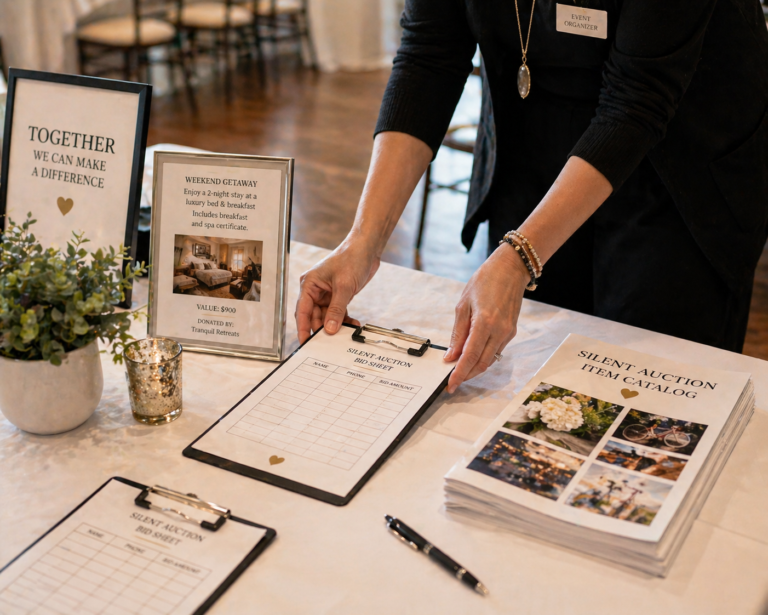
Practical revenue optimization tips that experienced auction organizers use
- Audit your last event’s closing prices against starting bids to identify where your formula needs adjustment.
- Walk the room as a bidder before doors open — you’ll immediately spot placement and flow problems.
- Assign a volunteer specifically to monitor bid activity and alert the emcee when items need a mention.
- Build a reserve price for every item and train volunteers on what to do if an item closes below it.
- Offer a “buy it now” price on select items at roughly 85% of fair market value to capture impulse purchases.
- Use numbered bid sheets to track which items are generating the most traffic throughout the night.
- Send a pre-event email to registered guests highlighting three or four featured lots to seed interest before arrival.
- Test your checkout system in a dry run — payment processing failures at close destroy the end-of-night experience.
Frequently asked questions about silent auction revenue optimization
How many items should a silent auction have to maximize revenue?
A commonly cited benchmark is one item per two to three expected attendees. Beyond that, you’re likely diluting bidder attention and producing more items with weak closing prices than you would with a smaller, curated catalog.
What is the best starting bid strategy for a silent auction?
Setting starting bids at 30–40% of fair market value is a widely used formula among experienced organizers. It’s low enough to invite the first bid without anchoring the item’s perceived value too far below its worth.
Does item placement really affect silent auction revenue optimization results?
Yes — items near natural traffic patterns (bars, entrances, dining areas) consistently attract more bids than items placed in low-traffic zones, regardless of value. Placement is a revenue decision.
Should I close all silent auction sections at the same time?
Staggered closings — releasing sections every 15–20 minutes — sustain bidding energy and give guests time to focus. Simultaneous closings create checkout bottlenecks and eliminate the urgency arc that drives late bids.
How do bid increments affect final auction revenue?
Increments set too low allow bidders to edge each other out by minimal amounts, keeping prices low. Increments at 10–15% of the starting bid push final values higher and reduce the number of rounds needed to reach a competitive price.
Key takeaways for improving your revenue optimization strategy
A well-designed silent auction isn’t just a fundraiser — it’s a revenue system, and every component of that system either supports or undermines the final number.
Key Takeaways:
Key Takeaways:
- Silent auction revenue optimization depends on catalog size, item placement, starting bids, bid increments, and closing structure — not just item quality.
- Starting bids set at 30–40% of fair market value generate more participation and stronger closing totals than bids chosen arbitrarily.
- Staggered closings and visible countdowns are among the highest-leverage, lowest-cost tactics available to any auction organizer.
- Volunteer engagement in the final 30 minutes of bidding has a measurable effect on how many items close above their starting price.
- A streamlined checkout experience protects donor goodwill and directly influences whether guests return to future events.
Explore More Silent Auction Resources
A successful silent auction fundraiser requires thoughtful planning, strong partnerships, and an engaging event experience. By understanding how auctions work and what motivates bidders, organizations can create events that raise meaningful support for their mission.
Explore our guides to learn more about:
Step-by-step guides explaining how silent auctions work, how to plan them, and how to run a successful fundraising event.
Explore proven strategies nonprofits use to plan, promote, and maximize fundraising results from silent auction events.
Download templates and tools that help nonprofits organize auction items, track bids, and manage fundraising events.
The Association of Fundraising Professionals offers research, ethical standards, and best practices to help nonprofits improve fundraising success.