
How to Fill the Room: A Silent Auction Promotion Guide
When promotion falls short, the consequences ripple through everything else. Sparse attendance means fewer bidders competing for each item, and fewer bidders means lower closing bids across the board. A poorly promoted event can cut your final raise by 30 to 40 percent compared to the same event with a well-executed outreach plan.
This guide walks through how silent auction promotion actually works — from building pre-event buzz to driving last-minute bids — so you can fill the room with motivated donors who are ready to bid.
Why silent auction promotion has such a big impact on silent auction results
The number of active bidders is the single biggest lever you control in a silent auction. Doubling the bidder pool doesn’t double your revenue — it often triples it, because competition compounds. Two bidders on an item produce one bid increment. Six bidders on the same item can produce eight or ten rounds of bidding before it closes.
Organizations that invest in a structured silent auction promotion strategy consistently outperform those that rely on word of mouth. Getting your promotion right is not a marketing nicety — it is a direct revenue decision.
How bidders actually think about a silent auction event
Consider a school auction that promoted a signed sports jersey in every pre-event email. Attendance jumped 22 percent compared to the prior year — not because the jersey was the most valuable item, but because it gave potential attendees a concrete reason to show up. One anchor item, promoted repeatedly, can carry your entire attendance campaign.
For nonprofits, the promotional challenge is layered: you’re selling both the mission and the experience. Donors want to feel good about attending, but they also want to have fun. Promotion that leans only on mission fatigue (“we need your help”) misses the motivational reality of what gets people to put on shoes and leave the house.
How to build a silent auction promotion strategy that drives attendance and bids
Start promoting at least six weeks out
Build a multi-channel outreach sequence
Feature specific items in every promotion
Create a pre-registration or RSVP path
Use peer-to-peer outreach for your top donors
Tease the item catalog before the event
Send a day-of reminder with logistics
Follow up with online bidding links if applicable
What silent auction promotion decisions lead to more attendance and higher bids
- Promoting specific items by name consistently outperforms generic event announcements.
- A six-week campaign produces more attendance than a two-week push with the same total number of messages.
- Personal invitations from board members convert at higher rates than any digital channel alone.
- Pre-event RSVPs reduce no-show rates and build a warm audience for final reminders.
- Posting item previews to social media generates organic sharing that paid promotion cannot replicate.
- Text message reminders sent the morning of the event reduce last-minute dropout significantly.
- Segmenting your email list — past attendees versus new prospects — improves open rates and relevance.
- Partnering with a local business or media sponsor expands your promotional reach beyond your existing contact list.
- Showcasing your mission impact alongside items reminds donors why the evening matters beyond the fun.
Common silent auction promotion mistakes that quietly reduce revenue
Starting too late. A two-week runway doesn’t give your audience time to plan. Six to eight weeks allows multiple touchpoints before the event date arrives.
Using only one channel. Email alone misses the portion of your audience that’s more active on social media or more responsive to a phone call. Multi-channel coverage is non-negotiable.
Describing items vaguely. “A gift basket” tells no one anything. “A spa gift basket with $200 in services from Serenity Day Spa” creates desire. Specificity sells.
Burying the event details. Some promotions lead so hard on mission messaging that the date, time, and location get lost. Logistics need to be impossible to miss.
Skipping a mobile bidding registration prompt. If your platform supports pre-registration, failing to push it before the event creates friction on the night itself and slows bidding momentum.
Ignoring past attendees as a separate segment. People who came last year are your warmest leads. Treating them identically to cold prospects wastes a high-conversion audience.
Sending one reminder and stopping. A single email is easy to miss or forget. A well-spaced sequence of three to five messages across the campaign period dramatically improves recall and attendance.
Practical silent auction promotion tips that experienced auction organizers use
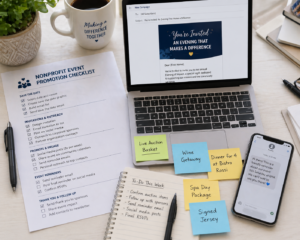 Send your “save the date” the moment the event date is confirmed — even if nothing else is ready.
- Use countdown language (“12 days left to register”) in subject lines to trigger urgency without being pushy.
- Record a short 60-second video of your event chair or executive director personally inviting supporters — video consistently outperforms static posts.
- Ask item donors to promote their own contributions on social media; their networks are new audiences for you.
- Create a Facebook event and update it weekly with item previews to keep the algorithm showing it to new people.
- Include a “bring a friend” line in every email — one sentence asking supporters to forward the invite multiplies reach at zero cost.
- Use your highest-value item as the centerpiece of your final push, not your first message — save your best hook for the moment decision-making peaks.
- Build a simple one-page event landing page with RSVP, item highlights, and mission context — link to it everywhere.
- Post bid opening and closing times prominently so guests can plan which tables to visit first.
- Thank early registrants publicly on social media — social proof encourages others to commit.
Frequently asked questions about silent auction promotion
How far in advance should I start promoting a silent auction?
What's the best channel for silent auction promotion?
Should I promote specific items before the silent auction?
How many promotional emails should I send before the event?
Does promoting mobile bidding before the event actually help?
Key takeaways for improving your silent auction promotion strategy
Key Takeaways:
- Silent auction promotion that features named items consistently outperforms generic event announcements in both attendance and final bids.
- Starting your campaign six to eight weeks out gives you the runway needed to build familiarity and urgency before the event.
- Multi-channel outreach — combining email, social media, text, and personal contact — reaches more of your potential audience than any single method.
- Personal invitations from board members and committee chairs are the highest-converting outreach tool in your promotional toolkit.
- Pre-event mobile bidding registration reduces friction on the night of the event and drives stronger early bidding momentum.
Explore More Silent Auction Resources
By understanding how auctions work and what motivates bidders, organizations can create events that raise meaningful support for their mission.