
Turning Donors Into Champions: Silent Auction Donor Engagement Tips
Silent auction fundraisers live and die by one thing most organizers underestimate: how connected donors feel to the cause before, during, and after the event. Procurement gets all the attention. Donor engagement quietly determines whether those items sell — and whether those donors come back. When bidders feel personally invested, they bid higher, stay longer, and bring friends next year.
Ignore donor engagement and you get a room full of people browsing items like a garage sale. They’ll pick up a bid sheet, glance at the starting price, and walk away. Without emotional connection, even a well-curated item table underperforms. The gap between a good auction and a great one is almost never the items — it’s the relationship between the donor and the mission.
This guide covers the strategies that experienced nonprofit event planners use to build real donor engagement at silent auctions — from pre-event outreach to post-event follow-up. You’ll learn how to warm up your audience before they arrive, keep them emotionally connected throughout the night, and convert one-time bidders into long-term supporters.
Ignore donor engagement and you get a room full of people browsing items like a garage sale. They’ll pick up a bid sheet, glance at the starting price, and walk away. Without emotional connection, even a well-curated item table underperforms. The gap between a good auction and a great one is almost never the items — it’s the relationship between the donor and the mission.
This guide covers the strategies that experienced nonprofit event planners use to build real donor engagement at silent auctions — from pre-event outreach to post-event follow-up. You’ll learn how to warm up your audience before they arrive, keep them emotionally connected throughout the night, and convert one-time bidders into long-term supporters.
Why silent auction donor engagement has such a big impact on fundraising results
Donor engagement isn’t a soft concept — it has a direct, measurable effect on how much your auction raises. Bidders who feel emotionally connected to your organization are more likely to push past their initial budget, bid on multiple items, and participate in any Fund-a-Need or paddle raise you run alongside the auction. Engagement drives competitive bidding, and competitive bidding drives revenue.
There’s also a retention dimension that most organizations miss entirely. A first-time attendee who leaves your event feeling seen and appreciated has a dramatically higher chance of attending next year, volunteering, or making an outright gift. Treat auction night as a transaction and you lose that compounding value. Treat it as a relationship-building opportunity and your donor pool grows with every event.
The bottom line is simple: organizations that prioritize silent auction donor engagement consistently outperform those that focus purely on item procurement or event logistics. The items get people through the door. The engagement keeps them bidding — and coming back.
There’s also a retention dimension that most organizations miss entirely. A first-time attendee who leaves your event feeling seen and appreciated has a dramatically higher chance of attending next year, volunteering, or making an outright gift. Treat auction night as a transaction and you lose that compounding value. Treat it as a relationship-building opportunity and your donor pool grows with every event.
The bottom line is simple: organizations that prioritize silent auction donor engagement consistently outperform those that focus purely on item procurement or event logistics. The items get people through the door. The engagement keeps them bidding — and coming back.
How bidders actually think about donor engagement during a silent auction
Most attendees arrive at a silent auction with a loose budget in mind and a vague sense that they’re there to “support a good cause.” What they’re really doing in the first fifteen minutes is deciding whether they belong in the room. If the environment feels warm, personal, and mission-driven, they lean in. If it feels corporate or generic, they go through the motions.
Consider a scenario: two identical items — a weekend at a lakefront cabin — are on two different auction tables. At one event, a short video plays showing families the organization served last year. At the other, there’s just a printed description and a starting bid. The cabin at the first event routinely sells for 20–30% more. The item didn’t change. The emotional context did.
In the nonprofit context, this psychology has an added layer: donors want to feel like insiders, not ticket buyers. When your engagement strategy gives them that feeling — through personal acknowledgment, mission storytelling, or behind-the-scenes access — they become advocates. That identity shift from “attendee” to “supporter” is what separates a one-night bidder from a multi-year donor.
Consider a scenario: two identical items — a weekend at a lakefront cabin — are on two different auction tables. At one event, a short video plays showing families the organization served last year. At the other, there’s just a printed description and a starting bid. The cabin at the first event routinely sells for 20–30% more. The item didn’t change. The emotional context did.
In the nonprofit context, this psychology has an added layer: donors want to feel like insiders, not ticket buyers. When your engagement strategy gives them that feeling — through personal acknowledgment, mission storytelling, or behind-the-scenes access — they become advocates. That identity shift from “attendee” to “supporter” is what separates a one-night bidder from a multi-year donor.
How to build silent auction donor engagement that drives higher bids and long-term loyalty
Send a personal warm-up email before the event
Don’t let your first real communication be the event reminder. Send a personal note one to two weeks out that tells a specific story about someone your organization helped this year. Donors who arrive already emotionally connected bid faster and higher.
Use name recognition at check-in
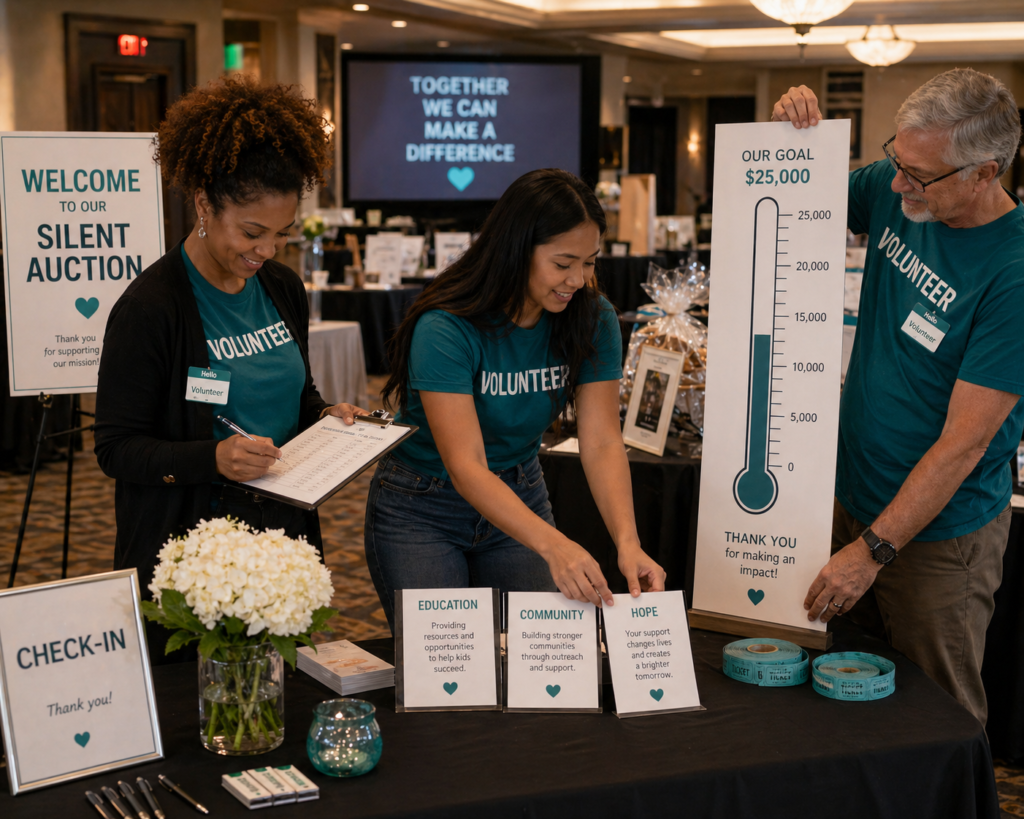
Train your check-in volunteers to greet attendees by name and thank them for coming. A single moment of personal acknowledgment at the door sets the tone for the entire evening and signals that donors are known, not just ticketed.
Place mission touchpoints near high-value items
Position a short impact statement, photograph, or testimonial card next to your top auction items. When a bidder pauses at a premium item, you want them reading something emotionally resonant — not just a price sheet.
Brief your board and key staff on donor conversations
Your board members are your most credible advocates. Give them a one-page talking guide with two or three impact stories and the names of major donors to seek out. Structured personal conversations at auctions measurably increase bidding activity.
Let beneficiaries speak — briefly
A 90-second live testimonial or video from someone your organization has directly helped is consistently one of the highest-ROI moves at any fundraising event. Keep it short, make it real, and time it for peak room energy.
Use live updates on fundraising progress
Display a running tally of bids raised, a thermometer graphic, or real-time milestone announcements. When donors see they’re collectively close to a goal, the pull to contribute — and bid higher — intensifies.
Follow up within 24 hours, personally
Send a thank-you message within 24 hours of the event that references something specific — a item they won, a conversation they had, or a milestone the event hit. Generic follow-up is forgettable. Specific follow-up builds loyalty.
Create a post-event impact report
One to two weeks after the event, send a brief report showing donors exactly what their participation made possible. This closes the loop, reinforces the relationship, and sets the stage for next year’s ask.
What silent auction donor engagement decisions lead to more revenue and retention
- Personalizing pre-event communication increases emotional investment before bidders even arrive.
- Positioning impact stories near auction items gives bidders a reason to stretch their budget.
- Training volunteers and board members to initiate donor conversations raises the energy level of the entire room.
- Acknowledging donors by name at check-in creates an immediate sense of belonging that influences bidding behavior throughout the night.
- Sharing a live fundraising goal creates a collective momentum that individual bids alone cannot generate.
- Featuring a brief beneficiary story during the event connects abstract giving to real human outcomes.
- Sending a personalized thank-you within 24 hours dramatically increases the likelihood of repeat attendance.
- Publishing a post-event impact report converts one-time supporters into long-term advocates.
- Segmenting donors by giving history allows you to tailor engagement intensity to your highest-potential prospects.
- Offering a behind-the-scenes preview or early check-in for major donors signals VIP status and deepens commitment.
Common donor engagement mistakes that quietly reduce silent auction revenue
- Relying on the items to do the emotional work.
Even the most desirable auction items can’t manufacture a connection to your mission — engagement strategy has to do that, and it starts well before bidding opens. - Sending only logistical emails before the event.
Emails about parking, check-in times, and schedules are necessary, but they don’t warm donors up. Every pre-event communication is an opportunity to build anticipation and emotional investment. - Neglecting first-time attendees.
Repeat donors often get the attention while first-timers drift. A simple welcome moment or brief orientation for new guests can convert a curious attendee into a committed donor. - Skipping the live program element.
Organizations that run a fully self-directed silent auction — no program, no announcements, no stories — consistently leave money on the table. Even a single well-timed mission moment changes the room. - Thanking everyone the same way.
A form letter sent to every attendee signals that no one was actually paying attention. Segmented, specific follow-up takes more effort but produces dramatically better retention. - Letting the event end without a next-step ask.
Donors leave most engaged immediately after a successful event. That’s the ideal moment to invite them to volunteer, subscribe to your newsletter, or save the date for next year — and most organizations miss it entirely. - Treating engagement as an event-night responsibility only.
Donor engagement is a year-round activity. Organizations that communicate with donors between events — updates, impact stories, volunteer opportunities — arrive at auction night with a warmer, more committed audience.
Practical donor engagement tips that experienced auction organizers use
- Start a donor engagement sequence at least three weeks before the event, not three days.
- Use your beneficiaries’ real stories — with permission — rather than organizational statistics alone.
- Create a printed “impact card” for each major auction item that ties the item to a specific program outcome.
- Assign a specific board member to each table or section to ensure every donor gets a personal interaction.
- Time your live mission moment for 45–60 minutes into the event, when energy and alcohol (if served) have loosened the room.
- Create a VIP early-access window for your top donors to preview items before general check-in begins.
- Send a segmented post-event survey to gather feedback and signal that their opinion matters.
- Train your emcee to reference donor impact — not just item descriptions — throughout the evening.
Frequently asked questions about donor engagement at silent auctions
What is the most effective donor engagement strategy for a silent auction?
The most effective silent auction donor engagement strategy combines personalized pre-event outreach with a live mission moment during the event. Donors who arrive emotionally connected and receive a real-time reminder of impact consistently bid more than those who don’t. Following up personally within 24 hours reinforces the relationship and improves retention.
Should I contact donors before a silent auction event?
Yes — pre-event communication is one of the highest-leverage donor engagement opportunities you have. Send at least two messages before the event: one focused on a mission story and one that builds excitement about specific items. Avoid limiting pre-event contact to logistics alone.
How do I keep donors engaged during the silent auction itself?
Keep donors engaged during the event by mixing social energy with mission moments — a brief testimonial, a live fundraising thermometer, or personal conversations initiated by board members. Auction-only events with no program element tend to feel transactional, which suppresses both bidding and retention.
Does donor engagement really affect how much a silent auction raises?
Yes, significantly. Organizations that invest in structured donor engagement — before, during, and after the event — consistently outperform those that focus only on item quality or logistics. Emotional connection to the mission is the single strongest predictor of whether a bidder pushes past their initial budget.
Why do some donors stop attending silent auctions after one year?
Donor attrition after a first event usually comes down to feeling anonymous or forgotten. When follow-up is generic, when no one acknowledged them at the event, and when the next communication they receive is another ticket-sale email, donors disengage. Personalized follow-up and year-round communication are the most reliable antidotes.
Key takeaways for improving your donor engagement strategy
A successful silent auction isn’t built on items alone — it’s built on how connected donors feel to your mission before, during, and after the event. The organizations that master silent auction donor engagement consistently raise more money and retain more supporters year over year.
Key Takeaways:
Key Takeaways:
- Silent auction donor engagement begins weeks before the event through personalized, mission-focused outreach — not just logistical updates.
- Emotional connection to your mission is the strongest predictor of whether bidders will exceed their initial budget.
- Live mission moments — testimonials, impact updates, fundraising thermometers — create collective momentum that individual bidding cannot.
- Personalized follow-up within 24 hours of the event is one of the highest-ROI steps in the entire donor engagement cycle.
- Treating auction night as a relationship-building opportunity, not just a revenue event, is what converts first-time attendees into long-term supporters.
Explore More Silent Auction Resources
A successful silent auction fundraiser requires thoughtful planning, strong partnerships, and an engaging event experience. By understanding how auctions work and what motivates bidders, organizations can create events that raise meaningful support for their mission.
Explore our guides to learn more about:
Step-by-step guides explaining how silent auctions work, how to plan them, and how to run a successful fundraising event.
Explore proven strategies nonprofits use to plan, promote, and maximize fundraising results from silent auction events.
Download templates and tools that help nonprofits organize auction items, track bids, and manage fundraising events.
The Association of Fundraising Professionals offers research, ethical standards, and best practices to help nonprofits improve fundraising success.