
Bundles That Bid Higher: A Silent Auction Bundling Guide
Silent auction item bundling is one of the most underused tools in fundraising — and most organizers don’t realize they’re leaving money on the table until the event is over. While individual items have a fixed perceived value, a well-constructed bundle creates something new: an experience, a gift, or an opportunity that didn’t exist before. That shift in perception is worth real money at the bid sheet.
When bundling goes wrong — or doesn’t happen at all — you end up with a table full of disconnected items, each competing for attention and each closing below its potential. Bidders scroll past a $50 restaurant gift card. They walk past a single round of golf. But pair them together with a bottle of wine and a weekend itinerary, and suddenly you have a “Date Night” package that generates a bidding war.
This guide covers how to build silent auction bundles that feel cohesive, command higher opening bids, and drive more competitive bidding — with specific strategies for nonprofits working with limited donations and limited time.
When bundling goes wrong — or doesn’t happen at all — you end up with a table full of disconnected items, each competing for attention and each closing below its potential. Bidders scroll past a $50 restaurant gift card. They walk past a single round of golf. But pair them together with a bottle of wine and a weekend itinerary, and suddenly you have a “Date Night” package that generates a bidding war.
This guide covers how to build silent auction bundles that feel cohesive, command higher opening bids, and drive more competitive bidding — with specific strategies for nonprofits working with limited donations and limited time.
Why silent auction item bundling has such a big impact on silent auction results
Every item on your silent auction table carries a ceiling — a mental number that bidders assign before they’ve even picked up a pen. A $100 spa gift card will rarely exceed $100, because people know exactly what it’s worth. Bundling breaks that ceiling by replacing a known value with a perceived experience value, which is almost always higher.
The mechanics are straightforward: when you group two or three related items into a themed package, the whole becomes greater than the sum of its parts. Bidders aren’t calculating retail value anymore — they’re imagining using the package. That emotional engagement drives bids up.
For nonprofits running on donated items, bundling is also a practical solution for items that are too low in value to stand alone. A $25 coffee shop card, a bag of locally roasted beans, and a ceramic mug become a “Coffee Lover’s Morning” package worth $80 at minimum bid — and worth considerably more to the right bidder. Getting bundling right is one of the highest-leverage decisions an auction organizer can make.
The mechanics are straightforward: when you group two or three related items into a themed package, the whole becomes greater than the sum of its parts. Bidders aren’t calculating retail value anymore — they’re imagining using the package. That emotional engagement drives bids up.
For nonprofits running on donated items, bundling is also a practical solution for items that are too low in value to stand alone. A $25 coffee shop card, a bag of locally roasted beans, and a ceramic mug become a “Coffee Lover’s Morning” package worth $80 at minimum bid — and worth considerably more to the right bidder. Getting bundling right is one of the highest-leverage decisions an auction organizer can make.
How bidders actually think about item bundling during a silent auction
Bidders move quickly and make decisions based on feeling, not spreadsheets. When someone stops at a bundle, they’re not adding up retail prices — they’re asking, “Could I use this? Would I give this as a gift? Does this feel special?” A bundle that answers yes to those questions earns a bid. A random assortment of items does not.
Consider a concrete example: two nearly identical packages — one labeled “Assorted Donated Items (Value: $180)” and another labeled “Spa Day for Two — Massage, Facial, and Lunch Gift Card.” Same retail value. The second package will consistently outperform the first because it sells a story, not a list.
In the nonprofit context, this psychology is even more powerful. Donors already want to give — they’re looking for permission to spend more. A compelling bundle gives them that permission by making the higher bid feel like a bargain on something they couldn’t easily assemble themselves.
Consider a concrete example: two nearly identical packages — one labeled “Assorted Donated Items (Value: $180)” and another labeled “Spa Day for Two — Massage, Facial, and Lunch Gift Card.” Same retail value. The second package will consistently outperform the first because it sells a story, not a list.
In the nonprofit context, this psychology is even more powerful. Donors already want to give — they’re looking for permission to spend more. A compelling bundle gives them that permission by making the higher bid feel like a bargain on something they couldn’t easily assemble themselves.
How to build silent auction item bundles that drive higher bids
Lead with a theme, not a list of items
Every bundle needs a unifying idea — “Girls’ Night Out,” “Family Game Night,” “Golf Getaway.” The theme is the first thing bidders read, and it determines whether they stop or walk past.
Set a minimum bid at 30–40% below perceived value
Bundles need room to climb. Price the opening bid low enough to invite the first bid quickly — momentum matters more than starting high.
Limit each bundle to three to five items
Too many items make a package feel cluttered and hard to evaluate. Three to five items hits the sweet spot between generosity and clarity.
Group items by use occasion, not by donor
Resist the urge to bundle whatever came in together. Curate by how a person would actually use the items — same occasion, same recipient, same mood.
Anchor the bundle with one aspirational item
Every strong package has a hero — a restaurant reservation, a spa treatment, a weekend getaway. Build the supporting items around that anchor.
Write a short narrative description for each bundle
Two to three sentences describing the experience the winner will have. “Enjoy a round of golf at Elmwood Country Club, then unwind with dinner for two at Harvest Kitchen and a bottle of local red wine.” That’s a bid.
Add a handwritten or printed value card
Display the total estimated retail value prominently. Bidders use it as a reference point — and they feel good “getting a deal” when they win at less.
Use consistent display materials across bundles
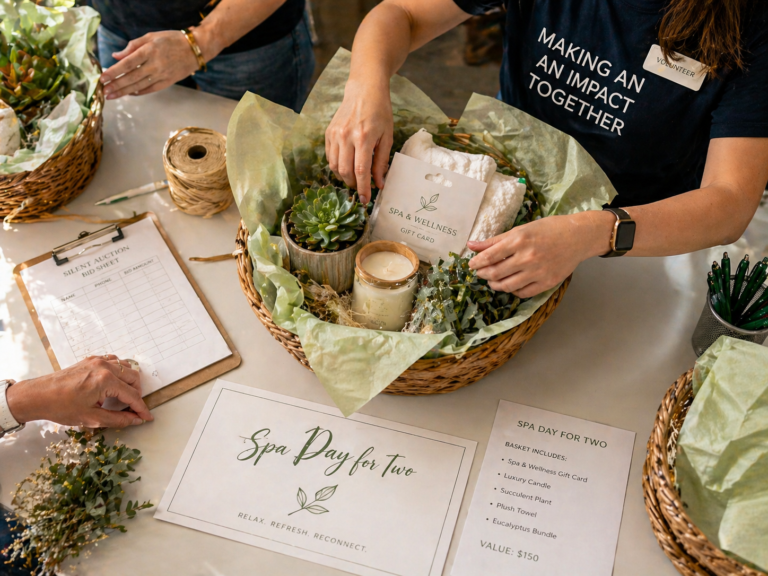
Coordinated signage, baskets, or boxes signal that care went into these packages. Presentation quality raises perceived value before anyone reads the description.
What item bundling decisions lead to more silent auction revenue
- Themed bundles consistently outbid same-value individual items because they sell an experience.
- Bundles with a clear recipient (“for the couple,” “for the golfer”) attract bidders who identify with that profile.
- Low-value items donated in multiples become strong bundles that would otherwise sit unbid.
- Opening bids set at 30–40% of perceived value generate faster first bids and longer bidding windows.
- Bundles displayed in a basket or box earn more attention than flat-laid items on a cloth.
- A printed retail value card anchors bidder expectations and validates a higher closing bid.
- Packages with a narrative description outperform packages with a plain item list.
- Limiting bundles to five items or fewer keeps the perceived value focused and the display clean.
- Pairing a local-business item with a nationally recognizable brand creates contrast that raises interest.
- Bundles that include an experiential item (a class, a tour, a reservation) close higher than all-product packages.
Common item bundling mistakes that quietly reduce silent auction revenue
- Building bundles around what you have, not what bidders want
Donors give what they can, but the organizer’s job is to curate. Rearrange donations into combinations that serve bidder desire, not donation logistics. - Using vague or generic bundle names
“Gift Basket #4” tells a bidder nothing. A name like “Backyard Entertainer” or “Night at the Theater” creates instant clarity and emotional pull. - Setting opening bids too high
Bundles priced near full retail value rarely get a first bid. Bidders need to feel like they’re getting ahead — not paying sticker price. - Ignoring display quality
A bundle dumped onto a table looks like a garage sale. A bundle arranged in a lined basket with a printed card looks like a gift worth winning. - Bundling items with mismatched audiences
A children’s toy and a wine-tasting voucher in the same package confuse the bidder. Every item should serve the same imagined winner. - Failing to include an experiential anchor
All-product bundles are forgettable. One experience item — even a simple cooking class or museum pass — transforms the package into something memorable. - Creating too many bundles of similar themes
Three “Date Night” packages split the bidder pool. Consolidate or differentiate clearly so each bundle competes for a distinct audience.
Practical item bundling tips that experienced auction organizers use
- Assign one person to own bundling decisions — committee design-by-committee produces incoherent packages.
- Photograph every bundle before the event for your website and social media promotion.
- Create a “mystery bundle” with a sealed box and a high opening bid — curiosity drives bids.
- Test bundle themes against your audience demographics before finalizing; what works at a gala differs from what works at a school carnival.
- Print a one-line “perfect for” note on each bundle card (e.g., “Perfect for the outdoor adventurer”).
- Reserve your two or three strongest bundles for the most visible spots on the table.
- Collect feedback after the event on which bundles generated the most interest — use it next year.
- Don’t over-bundle: keep 20–30% of items as standalone if they’re genuinely high-value and recognizable.
Frequently asked questions about silent auction item bundling
How many items should be in a silent auction bundle?
Three to five items is the sweet spot for most bundles. Fewer than three can feel thin; more than five becomes hard to evaluate quickly. Keep the package focused enough that a bidder can picture using every item.
Does silent auction item bundling actually raise more money than selling items individually?
In most cases, yes — especially for mid-range donated items. Bundling replaces a known retail value with a perceived experience value, which bidders are willing to pay more for. A well-themed bundle routinely closes above the combined individual value of its parts.
Should I display the retail value of each bundle?
Yes. A printed value card gives bidders a reference point and makes a winning bid feel like a deal. Without it, bidders tend to underbid because they’re uncertain about worth.
What makes a good anchor item for a silent auction bundle?
The best anchor items are experiential — a restaurant reservation, a spa treatment, a class, a round of golf. Experiences are harder to price and easier to romanticize, which makes them powerful bid drivers.
Why do some auction bundles get no bids at all?
Usually because the theme is unclear, the opening bid is too high, or the display is unappealing. A bundle that doesn’t tell a story in the first three seconds loses the bidder. Revisit the name, the description, and the presentation before assuming the items are the problem.
Key takeaways for improving your item bundling strategy
Item bundling is one of the most reliable ways to raise your auction’s average closing bid without sourcing a single additional donation. When packages are built around a clear theme, displayed with care, and priced to invite early bids, they consistently outperform their individual parts.
Key Takeaways:
Key Takeaways:
- Silent auction item bundling transforms disconnected donations into high-perceived-value experiences that drive competitive bidding.
- Theme-first bundling — organized by occasion or recipient — outperforms bundles built around whatever items happen to be available.
- Opening bids set at 30–40% below perceived value generate the momentum that leads to strong closing bids.
- Display quality directly affects perceived value; a basket with a printed card earns more attention than a flat-laid assortment.
- Experiential anchor items (reservations, classes, treatments) elevate any bundle and consistently produce the highest closing bids.
Explore More Silent Auction Resources
A successful silent auction fundraiser requires thoughtful planning, strong partnerships, and an engaging event experience. By understanding how auctions work and what motivates bidders, organizations can create events that raise meaningful support for their mission.
Explore our guides to learn more about:
Step-by-step guides explaining how silent auctions work, how to plan them, and how to run a successful fundraising event.
Explore proven strategies nonprofits use to plan, promote, and maximize fundraising results from silent auction events.
Download templates and tools that help nonprofits organize auction items, track bids, and manage fundraising events.
The Association of Fundraising Professionals offers research, ethical standards, and best practices to help nonprofits improve fundraising success.