
Sponsors Who Show Up: A Silent Auction Sponsorship Strategy Guide
Sponsorship is one of the most underdeveloped revenue streams in silent auction fundraising. Most organizations treat it as a last-minute ask rather than a structured strategy — and they leave significant money on the table as a result. When sponsors are brought in thoughtfully, they don’t just offset costs; they actively elevate the event.
Without a clear sponsorship strategy, you end up chasing commitments too late, accepting low-value in-kind donations that crowd your item tables, and missing the relationships that could fund future events. Worse, disorganized outreach signals to potential sponsors that your organization isn’t ready for a serious partnership.
This guide covers how to build a silent auction sponsorship strategy that attracts the right partners, structures your ask effectively, and creates value that makes sponsors want to return year after year.
Without a clear sponsorship strategy, you end up chasing commitments too late, accepting low-value in-kind donations that crowd your item tables, and missing the relationships that could fund future events. Worse, disorganized outreach signals to potential sponsors that your organization isn’t ready for a serious partnership.
This guide covers how to build a silent auction sponsorship strategy that attracts the right partners, structures your ask effectively, and creates value that makes sponsors want to return year after year.
Why silent auction sponsorship has such a big impact on fundraising results
Sponsorship revenue is fundamentally different from bid revenue — it’s committed before the event even begins. That predictability changes how you plan. When sponsorship covers your venue, catering, or technology costs, every dollar raised at the auction flows more directly to your mission. Organizations with strong sponsorship programs routinely see 30–50% of total event revenue come from sponsors rather than bids alone.
Beyond the dollars, sponsors amplify your reach. A business that co-promotes your event to its own customer base, email list, or social following can drive attendance and bidder participation in ways your own marketing can’t match. That multiplier effect compounds across every auction metric — more bidders mean more competition, which means higher final bids.
The long-term value is even greater. A sponsor who has a great experience at your event becomes a multi-year partner. Silent auction sponsorship strategy isn’t just an event tactic — it’s a relationship-building system that pays forward.
Beyond the dollars, sponsors amplify your reach. A business that co-promotes your event to its own customer base, email list, or social following can drive attendance and bidder participation in ways your own marketing can’t match. That multiplier effect compounds across every auction metric — more bidders mean more competition, which means higher final bids.
The long-term value is even greater. A sponsor who has a great experience at your event becomes a multi-year partner. Silent auction sponsorship strategy isn’t just an event tactic — it’s a relationship-building system that pays forward.
How businesses actually think about silent auction sponsorship during the giving season
Businesses that sponsor events aren’t simply writing charitable checks. They’re making a marketing and community relations decision. They’re asking: will this put our name in front of the right people, at the right moment, in a way that reflects well on us? Your pitch has to answer those questions before they’re asked.
Consider a local dental practice evaluating a sponsorship request for a school auction. They’re not moved by “support education” — they’re thinking about the 300 parents in that room who all need family dentistry. A $1,500 Gold Sponsorship that puts their logo on every paddle, their banner at the check-in table, and their name in the event program is a targeted marketing buy. When you frame your ask that way, the conversation changes entirely.
For nonprofits, this means your sponsorship deck has to speak two languages at once: mission impact for the heart, and marketing value for the budget holder. The organizations that close sponsorships reliably are the ones who understand that a business sponsor isn’t a donor — they’re a partner who expects a return.
Consider a local dental practice evaluating a sponsorship request for a school auction. They’re not moved by “support education” — they’re thinking about the 300 parents in that room who all need family dentistry. A $1,500 Gold Sponsorship that puts their logo on every paddle, their banner at the check-in table, and their name in the event program is a targeted marketing buy. When you frame your ask that way, the conversation changes entirely.
For nonprofits, this means your sponsorship deck has to speak two languages at once: mission impact for the heart, and marketing value for the budget holder. The organizations that close sponsorships reliably are the ones who understand that a business sponsor isn’t a donor — they’re a partner who expects a return.
How to build a silent auction sponsorship strategy that drives committed support
Define your sponsorship tiers before you make a single ask
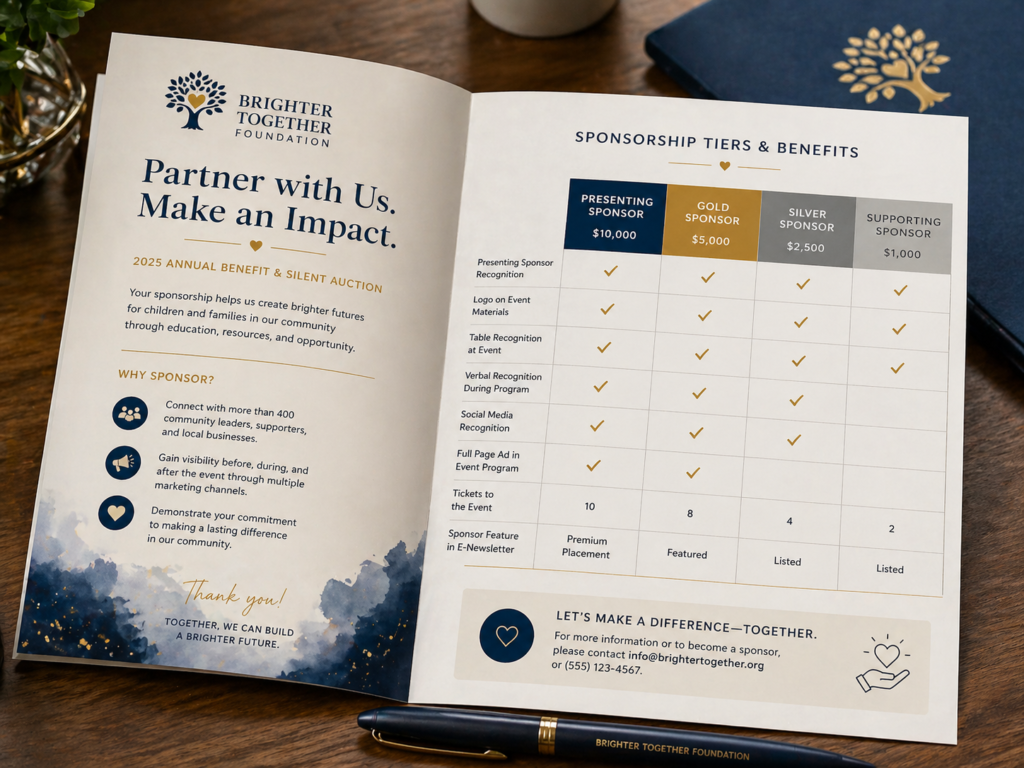
Build 3–4 clearly differentiated tiers — typically Presenting, Gold, Silver, and Supporting — with specific benefits at each level. Vague packages produce vague commitments.
Assign a dollar value to every benefit you offer
Logo placement, MC mentions, table signage, social media posts, and program ads all have quantifiable media value. List them. Sponsors evaluate ROI, and showing your math builds credibility.
Build your prospect list 90–120 days before the event
Late outreach is the single biggest sponsorship mistake. Target businesses with an existing connection to your cause, your geography, or your attendee demographic first.
Create a one-page sponsorship summary and a full deck
The one-pager gets forwarded to decision-makers. The full deck gets used in the meeting. Have both ready before outreach begins.
Assign a relationship owner to each prospect
Sponsorship outreach fails when it feels institutional. Every prospect should have one named person from your organization responsible for the relationship — ideally someone who already knows them.
Follow up exactly twice after the initial ask
One follow-up a week after the initial outreach, one final check-in two weeks after that. More than two follow-ups without a response damages the relationship; fewer than two leaves real money behind.
Deliver a post-event sponsor report within two weeks
Document reach, attendance, logo placements, and social impressions. Sponsors who receive a recap showing their value are dramatically more likely to renew.
Ask for a multi-year commitment at renewal
Once a sponsor has had a positive experience, the ask for a two-year renewal feels natural. Locking in recurring sponsors stabilizes your budget and reduces outreach work each cycle.
What silent auction sponsorship decisions lead to more committed partners
- Tiered packages with named benefits convert faster than open-ended asks.
- Prospect lists built around attendee demographics rather than geography alone attract higher-value sponsors.
- Personal outreach from a board member or executive director outperforms email blasts from a development coordinator.
- Sponsors offered exclusive category rights — such as “exclusive financial services sponsor” — are more likely to upgrade tiers.
- Early commitments secured before event marketing launches give sponsors more promotional visibility, making the package more attractive.
- Organizations that provide post-event impact reports see higher year-over-year renewal rates.
- Pairing sponsorship with a meaningful event moment — a mission video, a beneficiary story — reinforces the emotional ROI for partners.
- Flexible payment terms (net-30 invoicing rather than payment-upfront) remove a common friction point for small business sponsors.
- Naming rights on a specific auction section (“The [Sponsor Name] Travel Package Collection”) create a memorable association that drives renewals.
- Sponsors given a dedicated social media feature before the event report higher satisfaction and stronger intent to return.
Common silent auction sponsorship mistakes that quietly reduce fundraising results
- Reaching out too late
Sponsorship budgets at most businesses are allocated months in advance. Outreach with less than six weeks to go almost always finds an empty budget. - Offering only cash sponsorship tiers
Some businesses prefer in-kind contributions — products, services, or gift cards. Excluding them from your structure means leaving value on the table. - Generic benefit lists with no stated value
Telling a sponsor they’ll get “logo placement” without specifying where, how large, and in front of how many people makes the benefit feel abstract and unpersuasive. - Treating every sponsor the same regardless of tier
If your Gold and Silver sponsors receive the same day-of treatment, you’ve undermined your own tier structure and made upselling harder next year. - Failing to brief your emcee on sponsor acknowledgments
Sponsors who were promised verbal recognition and didn’t receive it will not renew — and they’ll remember. - Sending the thank-you too late
A thank-you that arrives more than a week after the event feels like an afterthought. Fast follow-up is a differentiator in sponsor relations. - Not asking for referrals from existing sponsors
A satisfied sponsor who recommends a peer business is the warmest possible introduction — most organizations never think to make the ask.
Practical silent auction sponsorship tips that experienced auction organizers use
- Start your prospect list by auditing last year’s event program for businesses already in your orbit.
- Use a simple CRM spreadsheet to track every sponsor contact, outreach date, and follow-up status.
- Give board members a templated outreach email they can personalize — removing the blank-page barrier increases participation.
- Offer a “Friends of the Event” micro-tier at $250–$500 to capture small businesses who want to participate but can’t commit to full sponsorship.
- Schedule a brief sponsor walk-through during event setup so partners see their signage in place before guests arrive.
- Include sponsor logos on bid sheets as a low-cost, high-visibility benefit that costs you nothing to add.
- Create a simple one-slide “why sponsor us” social proof insert showing attendance numbers, funds raised, and mission impact from the prior year.
- Confirm all sponsor deliverables in writing at the time of commitment — not the week of the event.
Frequently asked questions about silent auction sponsorship
How early should I start asking for silent auction sponsors?
Begin outreach at least 90–120 days before your event. Many businesses set charitable giving and marketing budgets quarterly or annually, so late outreach almost always finds a depleted budget. A strong silent auction sponsorship strategy depends on timing as much as pitch quality.
What should I include in a silent auction sponsorship package?
Each tier should include a specific list of tangible benefits: logo placement locations, social media features, event program ad size, verbal acknowledgments, and any exclusive rights being offered. Sponsors evaluate packages by the specificity and visibility of what they receive.
How many sponsorship tiers should a silent auction have?
Three to four tiers works well for most events. A Presenting or Title sponsor at the top, two middle tiers, and a lower entry tier allows you to capture a wide range of giving capacity without making the structure feel overwhelming.
Does having sponsors really increase silent auction revenue?
Yes — beyond covering event costs, sponsors who co-promote your event expand your bidder pool. More attendees mean more competition per item, which directly drives final bid prices higher. Silent auction sponsorship strategy creates a revenue multiplier that bids alone can’t replicate.
Why do some businesses decline silent auction sponsorship requests?
The most common reasons are: outreach arrived after their budget was committed, the benefits offered didn’t align with their marketing goals, or the ask felt transactional rather than relational. Personalizing your outreach and framing sponsorship as a marketing partnership rather than a donation addresses all three objections.
Key takeaways for improving your silent auction sponsorship strategy
Building a strong silent auction sponsorship strategy means treating sponsors as partners, not afterthoughts — and structuring your program to deliver real, documented value at every tier.
Key Takeaways:
Key Takeaways:
- Start sponsor outreach 90–120 days before the event to reach businesses before their budgets are committed.
- Tiered packages with specific, valued benefits convert faster than generic or open-ended asks.
- A strong silent auction sponsorship strategy frames the ask as a marketing partnership, not a charitable donation.
- Post-event sponsor reports are one of the most effective tools for driving multi-year renewals.
- Board member outreach consistently outperforms mass email when it comes to closing sponsorship commitments.
Explore More Silent Auction Resources
A successful silent auction fundraiser requires thoughtful planning, strong partnerships, and an engaging event experience. By understanding how auctions work and what motivates bidders, organizations can create events that raise meaningful support for their mission.
Explore our guides to learn more about:
Step-by-step guides explaining how silent auctions work, how to plan them, and how to run a successful fundraising event.
Explore proven strategies nonprofits use to plan, promote, and maximize fundraising results from silent auction events.
Download templates and tools that help nonprofits organize auction items, track bids, and manage fundraising events.
The Association of Fundraising Professionals offers research, ethical standards, and best practices to help nonprofits improve fundraising success.